

Question
Write a program to solve a Sudoku puzzle by filling the empty cells.
A sudoku solution must satisfy all of the following rules:
- Each of the digits
1-9must occur exactly once in each row. - Each of the digits
1-9must occur exactly once in each column. - Each of the digits
1-9must occur exactly once in each of the 93x3sub-boxes of the grid.
The '.' character indicates empty cells.
Example 1:
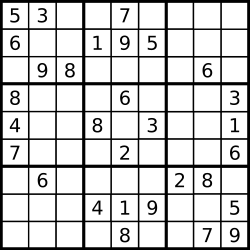
Input: board = [["5","3",".",".","7",".",".",".","."],["6",".",".","1","9","5",".",".","."],[".","9","8",".",".",".",".","6","."],["8",".",".",".","6",".",".",".","3"],["4",".",".","8",".","3",".",".","1"],["7",".",".",".","2",".",".",".","6"],[".","6",".",".",".",".","2","8","."],[".",".",".","4","1","9",".",".","5"],[".",".",".",".","8",".",".","7","9"]] Output: [["5","3","4","6","7","8","9","1","2"],["6","7","2","1","9","5","3","4","8"],["1","9","8","3","4","2","5","6","7"],["8","5","9","7","6","1","4","2","3"],["4","2","6","8","5","3","7","9","1"],["7","1","3","9","2","4","8","5","6"],["9","6","1","5","3","7","2","8","4"],["2","8","7","4","1","9","6","3","5"],["3","4","5","2","8","6","1","7","9"]] Explanation: The input board is shown above and the only valid solution is shown below:

Constraints:
board.length == 9board[i].length == 9board[i][j]is a digit or'.'.- It is guaranteed that the input board has only one solution.
Python Solution
class Solution:
    def solveSudoku(self, board: List[List[str]]) -> None:
        """
        Do not return anything, modify board in-place instead.
        """
        for i in range(9):
            for j in range(9):
                if board[i][j]!='.':
                    board[i][j] = int(board[i][j])
                else:
                    board[i][j] = 0

        def return_empty(board):
            for i in range(9):
                for j in range(9):
                    if board[i][j]==0:
                        return(i,j)
            return None

        def check(board,num,pos):
            row,col = pos

            # checking row
            for i in range(9):
                if board[row][i]==num and i!=col:
                    return False

            # checking col
            for i in range(9):
                if board[i][col]==num and i!=row:
                    return False

            # checking for sub-grid
            box_x = row//3
            box_y = col//3

            for i in range(box_x*3,box_x*3+3):
                for j in range(box_y*3,box_y*3+3):
                    if board[i][j]==num and (i,j)!=pos:
                        return False
            return True

        def solve(board):
            vacant = return_empty(board)
            if vacant is None:return True #means all cella are filled now and we have completed the sudoku
            row,col = vacant
            for i in range(1,10):
                if check(board,i,vacant):
                    board[row][col] = i
                    if solve(board):
                        return True
                    board[row][col] = 0
            return False

        solve(board)

        for i in range(9):
            l = ''
            for j in range(9):
                l+=str(board[i][j])
            board[i] = l
![[Solved] You are given an integer n and an integer start. Define an array nums where nums[i] = start + 2 * i (0-indexed) and n == nums.length. Return the bitwise XOR of all elements of nums.](https://machinelearningprojects.net/wp-content/uploads/2022/09/Leetcode-solutions-MLP-Feature-Image-1024x536.webp)