

Question
Given the root of a binary search tree, and an integer k, return the kth smallest value (1-indexed) of all the values of the nodes in the tree.
Example 1:
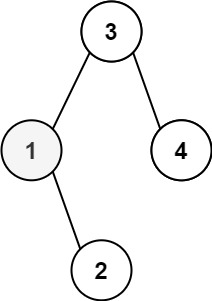
Input: root = [3,1,4,null,2], k = 1
Output: 1
Example 2:
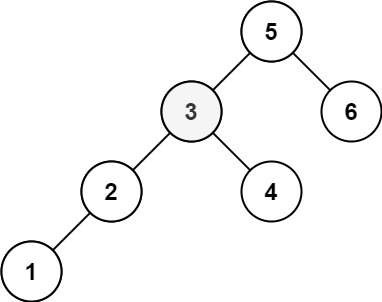
Input: root = [5,3,6,2,4,null,null,1], k = 3
Output: 3
Constraints:
- The number of nodes in the tree is
n. 1 <= k <= n <= 1040 <= Node.val <= 104
Follow up: If the BST is modified often (i.e., we can do insert and delete operations) and you need to find the kth smallest frequently, how would you optimize?
Python Solution
# Definition for a binary tree node.
# class TreeNode:
#     def __init__(self, val=0, left=None, right=None):
#         self.val = val
#         self.left = left
#         self.right = right
def inorder(root,res,k):
    if root==None:return
    heapq.heappush(res,-root.val)
    if len(res)>k:heapq.heappop(res)
    inorder(root.left,res,k)
    inorder(root.right,res,k)

class Solution:
    def kthSmallest(self, root: TreeNode, k: int) -> int:
        res = []
        heapq.heapify(res)
        inorder(root,res,k)
        return -res[0]
![[Solved] You are given an integer n and an integer start. Define an array nums where nums[i] = start + 2 * i (0-indexed) and n == nums.length. Return the bitwise XOR of all elements of nums.](https://machinelearningprojects.net/wp-content/uploads/2022/09/Leetcode-solutions-MLP-Feature-Image-1024x536.webp)