

Question
Given a 2D grid of size m x n and an integer k. You need to shift the grid k times.
In one shift operation:
- Element at
grid[i][j]moves togrid[i][j + 1]. - Element at
grid[i][n - 1]moves togrid[i + 1][0]. - Element at
grid[m - 1][n - 1]moves togrid[0][0].
Return the 2D grid after applying shift operation k times.
Example 1:
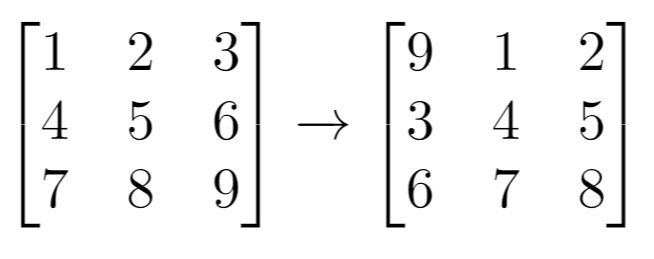
Input: grid = [[1,2,3],[4,5,6],[7,8,9]], k = 1
Output: [[9,1,2],[3,4,5],[6,7,8]]
Example 2:
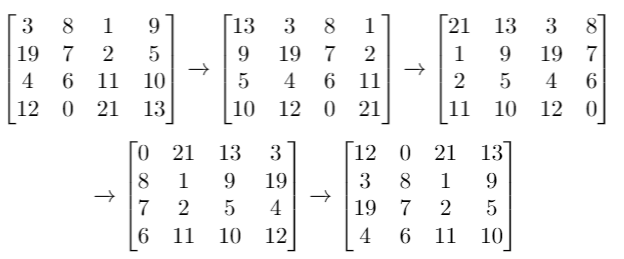
Input: grid = [[3,8,1,9],[19,7,2,5],[4,6,11,10],[12,0,21,13]], k = 4
Output: [[12,0,21,13],[3,8,1,9],[19,7,2,5],[4,6,11,10]]
Example 3:
Input: grid = [[1,2,3],[4,5,6],[7,8,9]], k = 9
Output: [[1,2,3],[4,5,6],[7,8,9]]
Constraints:
m == grid.lengthn == grid[i].length1 <= m <= 501 <= n <= 50-1000 <= grid[i][j] <= 10000 <= k <= 100
Python Solution
class Solution:
    def shiftGrid(self, grid: List[List[int]], k: int) -> List[List[int]]:
        c,nums = len(grid[0]),sum(grid,[])
        k = k % (len(nums))
        nums = nums[-k:] + nums[:-k]
        return ( [nums[i:i+c] for i in range(0,len(nums),c)] )
![[Solved] You are given an integer n and an integer start. Define an array nums where nums[i] = start + 2 * i (0-indexed) and n == nums.length. Return the bitwise XOR of all elements of nums.](https://machinelearningprojects.net/wp-content/uploads/2022/09/Leetcode-solutions-MLP-Feature-Image-1024x536.webp)