

Question
Given the root of a binary search tree (BST) with duplicates, return all the mode(s) (i.e., the most frequently occurred element) in it.
If the tree has more than one mode, return them in any order.
Assume a BST is defined as follows:
- The left subtree of a node contains only nodes with keys less than or equal to the node’s key.
- The right subtree of a node contains only nodes with keys greater than or equal to the node’s key.
- Both the left and right subtrees must also be binary search trees.
Example 1:
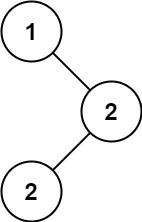
Input: root = [1,null,2,2]
Output: [2]
Example 2:
Input: root = [0]
Output: [0]
Constraints:
- The number of nodes in the tree is in the range
[1, 104]. -105 <= Node.val <= 105
Follow up: Could you do that without using any extra space? (Assume that the implicit stack space incurred due to recursion does not count).
Python Solution
# Definition for a binary tree node.
# class TreeNode:
#     def __init__(self, val=0, left=None, right=None):
#         self.val = val
#         self.left = left
#         self.right = right
def traversal(root):
    global l,prev,max_count,current_count,result
    if root==None:return
    traversal(root.left)

    current_count=1 if root.val!=prev else current_count + 1
    if current_count == max_count:
        result.append(root.val)
    elif current_count>max_count:
        result = [root.val]
        max_count = current_count
    prev = root.val

    traversal(root.right)

class Solution:
    def findMode(self, root: TreeNode) -> List[int]:
        global l,prev,max_count,current_count,result
        l = []
        prev = None
        max_count = 0
        current_count = 0
        result = []
        traversal(root)
        return result
![[Solved] You are given an integer n and an integer start. Define an array nums where nums[i] = start + 2 * i (0-indexed) and n == nums.length. Return the bitwise XOR of all elements of nums.](https://machinelearningprojects.net/wp-content/uploads/2022/09/Leetcode-solutions-MLP-Feature-Image-1024x536.webp)